
Optical particle counters, or OPCs for short, are scientific instruments used to measure the size and concentration of airborne aerosol particles. This is often visualised as a size distribution – a histogram that has particle diameter along the x-axis and number of particles per unit diameter along the y-axis.
An OPC is an in-situ instrument, meaning it measures the properties of the air exactly where the instrument is located. By comparison, a remote sensing instrument (like a lidar or a radar) measures the properties of the air some distance away (typically metres to kilometres away).
An OPC will always use some sort of light source (the optical bit) which it shines onto individual aerosol particles (the particle bit) and then it counts and measures the intensity of the flashes of light bouncing of the particles (the counter bit).
This diagram gives a good example of a typical OPC. It’s from the open access article On the importance of the flow field in inexpensive optical aerosol particle counting and sizing by Charis Loizidis and co-authors.
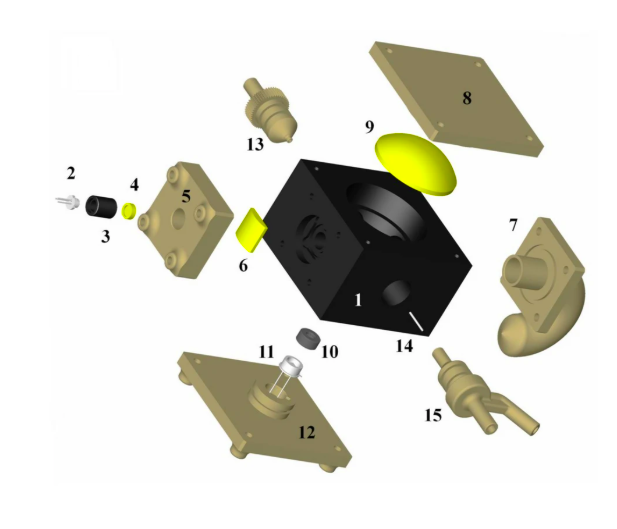
The air sample is sucked in through the inlet (15) and passes through the black optical block (14). At the same time, a laser (2) emits a beam in a perpendicular direction across the optical block into a beam dump (7). Whenever a particle in the sample passes through the laser beam, it generates a flash of light. A curved mirror (9) focuses some of that light onto a detector (11). This causes a voltage pulse.
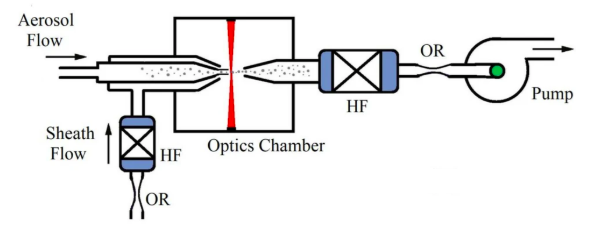
Here’s a schematic version of the same OPC. In this case, the curved mirror is out of the page, and the detector is into the page. The items labelled HF are filters and the items labelled OR are orifices used to measure/control the flow. The sheath flow helps to contain the aerosol particles and focus them into the centre of the laser.
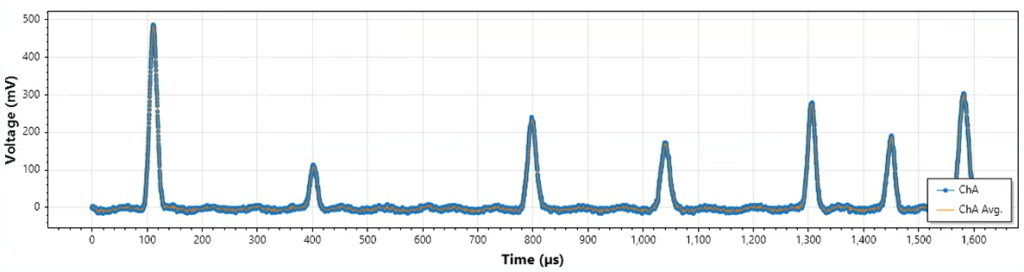
The OPC counts voltage pulses to measure the particle-detection rate, and it measures the pulse height to determine each particle’s size. Here’s a set of pulses measured by the CROPC prototype. Each of these pulses represents a single particle passing through the instrument.
For larger particles, we can swap the enclosed optical block for an open tube or a pair of arms with the laser passing between them. Examples of these include the Cloud Droplet Probe and Cloud and Aerosol Spectrometer, both manufactured by Droplet Measurement Technologies.
This type of OPC, often called an open beam OPC, is better suited to larger particles for a number of reasons. It’s harder to direct larger particles into an optical cavity through an inlet, so it’s best avoided where possible. Also, the light flash for larger particles is brighter, so we’re less worried about ambient light. Another important difference is that larger particles scatter most of the light into a narrow cone along the laser beam axis. This means we need a specialised optical configuration, which is more suited to an arm-style or tube-style configuration.
If you are looking for a best-in-class OPC to measure aerosol particles as small as 100 nm, then consider signing up for our pre-sales for the CROPC or apply to become an early adopter.